Virtual machines
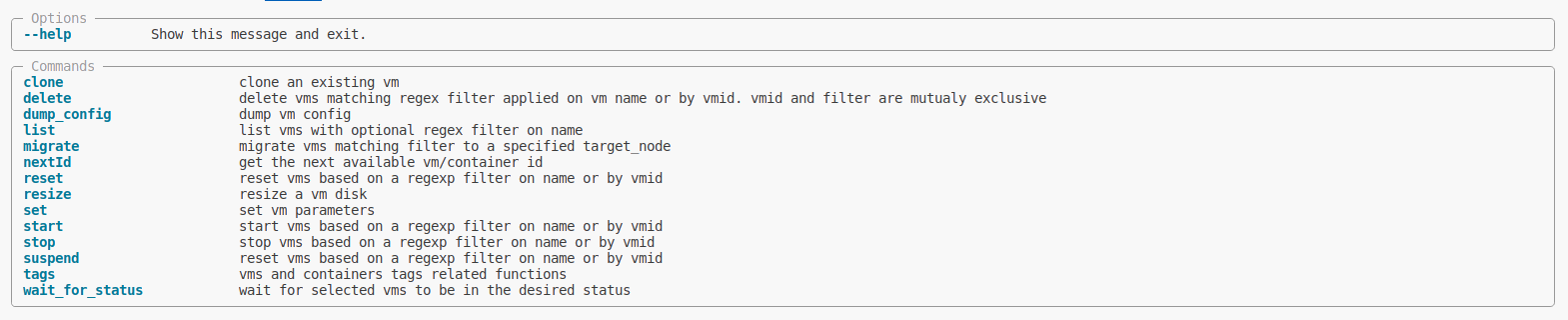 !
!
!

| option | description | Allowed values |
|---|---|---|
| filter-name | apply a regex filter on virtual machines name | regex string |
| output-format | output the result of the list command in the selected format (default to table) | table or yaml or json |
| proxmox-node | coma separated list of proxmox nodes where we will search for virtual machines | node1,node2,node3 |
| status | virtual machine status | running or stopped |
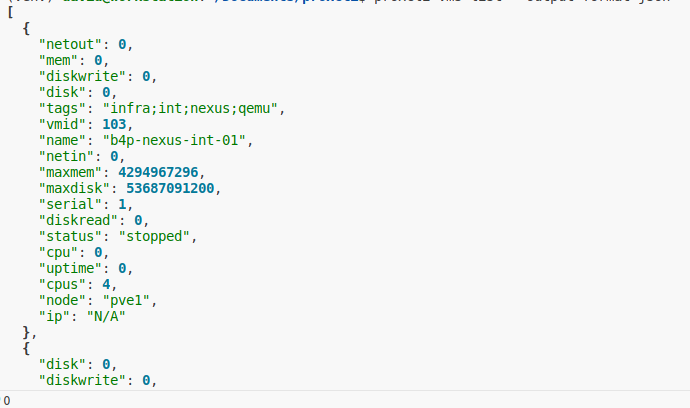
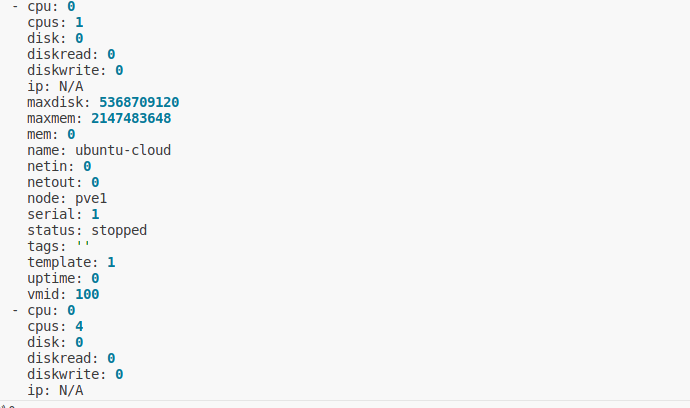
proxcli vms listproxcli vms list --proxmox-nodes pve1,pve2proxcli vms list --filter-name "^b4p-"proxcli vms list --status runningproxcli vms list --status running --proxmox-node pve2 --filter-name ".*powerdns.*"In the previous exemples, the result is formated as a nice table. you can specify other output formating such as json or yaml. just add the output-format argument. This argument take one of table, yaml or json value.
| table | json | yaml |
|---|---|---|
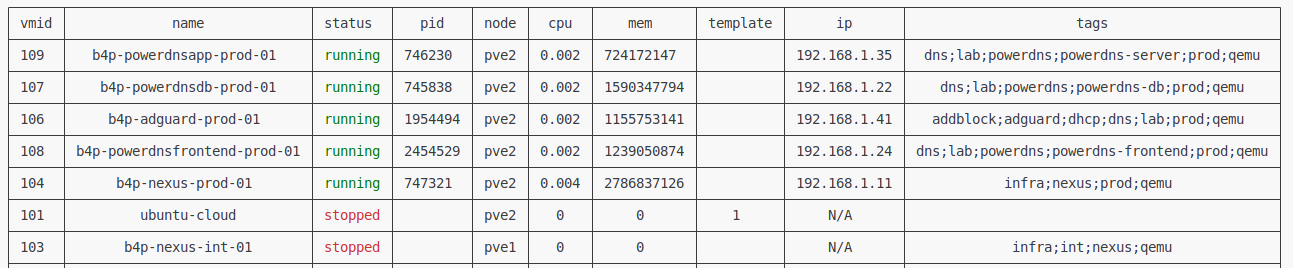
| 
| 
|

| option | description | Allowed values |
|---|---|---|
| vmid | virtual machine template id to be cloned | integer |
| name | virtual machine clone name | regex string |
| vm-description | virtual machine clone description | string |
| full-clone | A full clone VM is a complete copy and is fully independant to the original VM or VM Template, but requires the same disk space as the original. | N/A |
| storage | storage name (local or remote) where the virtual machine disk image will be cloned | string |
| target | the target proxmox node name where the cloned virtual machine will be assigned | string |
| block | will the clone process will block until it end ? It make sense on slow remote storage (like on NAS), we wait for the clone task to finish before doing the next clone. This prevent IO saturation on storage | N/A |
| duplicate | how many duplicate do we need ? each duplicate will get his name suffixed by an index. | integer |
vmid and name are mutualy exclusive
proxcli vms clone --vmid 111 --name test --vm-description test --full-clone --block --target pve2 --storage b4papp This is the same command as for a normal clone but you need additional steps to set user, password, ssh public key and network configuration. Try the following commands after cloning finishes.
proxcli vms set --vmid 112 --ciuser myuser --cipassword mypassword --ipconfig "ip=dhcp" --sshkey "$(cat ~/.ssh/id_rsa.pub)"
proxcli vms set --vmid 112 --cores 4 --memory 4096
proxcli vms resize --vmid 112 --disk virtio0 --size "50G"Make sure you already have a cloud init enabled template on your proxmox nodes. You can find in the next section an example of creating an ubuntu server cloud init enabled image.
you will need virt-customize tool on your proxmox nodes in order to install qemu-guest-agent (install it with apt install libguestfs-tools) you also need an ubuntu cloud-init enabled image. You can find one here
virt-customize -a lunar-server-cloudimg-amd64.img --install qemu-guest-agent
virt-customize -a lunar-server-cloudimg-amd64.img --run-command "echo -n > /etc/machine-id"Those commands will help you create an ubuntu cloud init enabled virtual machine template. Adjust the variables at the begining of the script so it match your needs.
vmid=$(pvesh get /cluster/nextid)
isopath="/mnt/pve/isos/template/iso/lunar-server-cloudimg-amd64.img"
templatename="lunar-server-cloudinit"
memory=2048
storage="b4papp"
scsihw="virtio-scsi-pci"
devname="virtio"
disksize="5G"
qm create $vmid  --memory ${memory} --name ${templatename} --net0 virtio,bridge=vmbr0
qm set $vmid --agent enabled=1
qm importdisk $vmid $isopath $storage
qm set $vmid --scsihw $scsihw --${devname}0 ${storage}:${vmid}/vm-${vmid}-disk-0.raw
qm set $vmid --ide2 ${storage}:cloudinit
qm set $vmid --boot c --bootdisk ${devname}0
qm resize $vmid ${devname}0 ${disksize}
qm set ${vmid} --serial0 socket --vga serial0
qm template ${vmid}On some shared storages (like Synology NFS share), you may encounter the following error with qm template command:
/usr/bin/chattr: Operation not supported while reading flags on /mnt/pve/b4papp/images/111/base-111-disk-0.rawYou don’t have to do anything, it is just a limitation in synology hardening. But it does not affect the creation of a template.

| option | description | Allowed values |
|---|---|---|
| vmid | The (unique) ID of the VM. | integer |
| vmname | Virtual Machine exact name | string |
| cores | The number of cores per socket. | integer |
| sockets | The number of CPU sockets. | integer |
| cpulimit | Limit of CPU usage. NOTE: If the computer has 2 CPUs, it has total of ‘2’ CPU time. Value ‘0’ indicates no CPU limit. | integer |
| memory | Amount of RAM for the VM in MiB. This is the maximum available memory when you use the balloon device. | integer |
| ipconfig | cloud-init: Specify IP addresses and gateways for the corresponding interface. IP addresses use CIDR notation, gateways are optional but need an IP of the same type specified. The special string ‘dhcp’ can be used for IP addresses to use DHCP, in which case no explicit gateway should be provided. For IPv6 the special string ‘auto’ can be used to use stateless autoconfiguration. This requires cloud-init 19.4 or newer. If cloud-init is enabled and neither an IPv4 nor an IPv6 address is specified, it defaults to using dhcp on IPv4. | string |
| cipassword | cloud-init: Password to assign the user. Using this is generally not recommended. Use ssh keys instead. Also note that older cloud-init versions do not support hashed passwords. | string |
| ciuser | cloud-init: User name to change ssh keys and password for instead of the image’s configured default user. | string |
| citype | Specifies the cloud-init configuration format. The default depends on the configured operating system type ostype. We use the nocloud format for Linux, and configdrive2 for windows. | string |
| boot | Specify guest boot order. Use the ‘order=’ sub-property as usage with no key or ’legacy=’ is deprecated. | string |
| sshkey | cloud-init: Setup public SSH key | string |
Set parameters is a small subset of what is available in the proxmox API. I (maybe) will had more parameters later.
assert we have already cloned a cloud init enabled ubuntu virtual machine with the following command:
proxcli vms clone --vmid 100 --full-clone --block --name ubuntu-cloud-init-clone --vm-description exemple_clone --target pve1 --storage b4pappthe cloned vm is not started yet
proxcli vms set --vmid 110 --ciuser myuser --cipassword mypassword --ipconfig "ip=dhcp" --sshkey "$(cat ~/.ssh/id_rsa.pub)"proxcli vms set --vmid 110 --cores 4 --memory 4096proxcli vms start --vmid 111
| option | description | Allowed values |
|---|---|---|
| vmid | the virtual machine id from which you want to resize the disk | string |
| vmname | the virtual machine name from which you want to resize the disk | string |
| filter-name | regex selector applied on virtual machines names you want to resize the disk | string |
| disk | the disk name in virtual machine config (usualy the one associated with bootdisk) | string |
| size | The desired size of the disk (Ex: 50G) | string |
vmid, vmname and filter-name are mutualy exclusive
proxcli vms resize --vmid 111 --disk virtio0 --size "60G"
| option | description | Allowed values |
|---|---|---|
| vmid | the virtual machine id you want to delete | string |
| filter-name | a regex applied on virtual machine name | string |
| confirm | does not ask for confirmation | N/A |
| block | block the command until it finished | N/A |
proxcli vms delete --vmid 111proxcli vms delete --filter-name "^b4p"proxcli vms delete --filter-name "^b4p" --confirm --block
| argument | description | Allowed values |
|---|---|---|
| vmid | virtual machine from which we want to dump the config | integer |
proxcli vms dump_config 111
| option | description | Allowed values |
|---|---|---|
| vmid | The virtual machine id to migrate | integer |
| filter-name | A regex string to select multiple virtual machines to be migrated | string regex |
| target-node | the proxmox target node name | string |
vmid and filter-name are mutualy exclusive
You can’t migrate a running virtual machine. The only way to do live migration is through cluster ha resource migrate. See cluster ha section
proxcli vms migrate --vmid 111 --target-node pve2 proxcli vms migrate --filter-name "^b4p" --target-node pve2| option | description | Allowed values |
|---|
proxcli vms nextId

| option | description | Allowed values |
|---|
proxcli vms tags list
| option | description | Allowed values |
|---|---|---|
| vm-tags | coma separated list of tags | string |
| filter-name | regex applied to match virtual machine names | string |
| set-mode | whether we can append or replace tags. default to replace | string |
proxcli vms tags set --vm-tags "template,ubuntu" --filter-name "^ubuntu-cloud"proxcli vms tags set --vm-tags "newtag" --filter-name "^ubuntu-cloud" --set-mode appendVirtual machine status commands use the same options interface for every desired status. The following options table apply to all status commands such as start, stop, suspend or reset.
| option | description | Allowed values |
|---|---|---|
| vmid | the virtual machine id you want to delete | string |
| filter-name | a regex applied on virtual machine name | string |
proxcli vms start --vmid 101proxcli vms stop --vmid 101proxcli vms suspend --filter-name "^b4p"proxcli vms reset --vmid 101
wait for virtual machines to reach the desired status (stopped, running …)
| option | description | Allowed values |
|---|---|---|
| vmid | the virtual machine id you want to wait for reaching the desired status | string |
| name | the virtual machine name you want to wait for reaching the desired status | string |
| filter-name | a regex applied on virtual machine name you want to wait for reaching the desired status | string |
| status | the desired status | string |
vmid, name and filter-name are mutualy exclusive
proxcli vms wait_for_status --filter-name "^test" --status "stopped"